
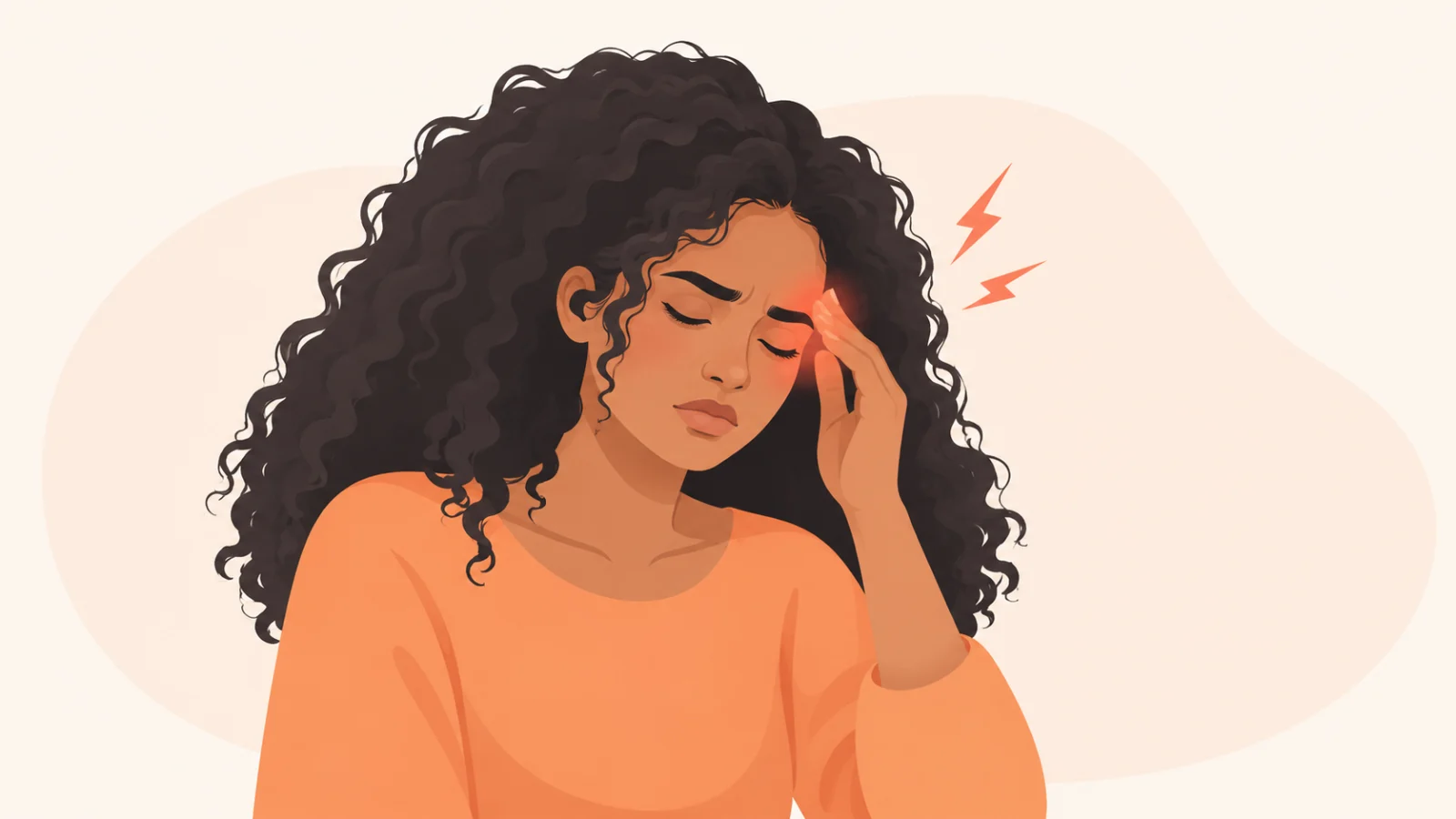
Migraine Behind the Eye: Why the Pain Settles on One Side
You get a pulsing ache that seems to sit right behind one eye, and you wonder if a migraine behind the eye is what you're dealing with. Or the pain hugs your temple. Or it's on the left today and was on the right last time, and you wonder if that's normal.
Migraine behind the eye is very common, and so is pain on just one side of the head. This article explains where migraine pain typically shows up, why it can move around, and how to tell it apart from other headaches, including cluster headache. It's one piece of our guide to migraine symptoms.
In short
- Migraine pain is often on one side of the head and can sit behind the eye, at the temple, or spread to the face, jaw or neck.
- The side can change from one attack to the next, and an attack can start on one side and spread to both.
- Cluster headache also hurts around one eye, but it is shorter, much more intense and comes with a red, watering eye and restlessness.
- Sudden, severe or unusual pain, or pain with other worrying symptoms, deserves prompt medical advice.
Where does migraine pain usually show up?
Migraine pain most often sits on one side of the head, but it isn't limited to one spot. The NHS describes the main symptom as a throbbing headache, often on one side of the head, that gets worse when you move around.
According to the Cleveland Clinic, you may also feel the pain around your eyes or temple, and sometimes around your face, sinuses, jaw or neck. So "behind the eye", "in the temple" and "from the neck up" can all be migraine.
Here are the places people describe most often:
- Behind or around one eye, sometimes with a feeling of pressure.
- At the temple, often pulsing with your heartbeat.
- One side of the forehead or head, from front to back.
- The back of the head and neck, either as the start of an attack or alongside it.
- The face, cheek or jaw, which is why migraine is often mistaken for a sinus headache.
If the pain is accompanied by nausea, sensitivity to light or sound, or lasts hours to days, that fits the pattern described in our guide on migraine vs headache. The location alone never decides it.
Why is migraine behind the eye so common?
Pain behind the eye is common in migraine because the nerves and blood vessels around the eye and temple are part of the system that carries pain signals during an attack. The Cleveland Clinic explains that during a migraine, nerves in the blood vessels of the head send pain signals to the brain and release inflammatory substances.
The trigeminal nerve is a big part of the story. It carries sensation from your face, scalp and the area around your eye, which is a likely reason the eye and temple feel so involved. Scientists are still working out the exact chain of events, and our article on what causes migraines goes into what we do and don't know.
Some people feel the eye pain together with visual changes. The Cleveland Clinic notes that in ocular (retinal) migraine the headache tends to sit right behind the affected eye, and the visual symptoms usually last between five and 60 minutes. If your vision changes in one eye, our complete guide to ophthalmic migraine explains the difference between aura, retinal migraine and an eye problem.
Can migraine switch sides from one attack to the next?
Yes, migraine very often changes sides, and that's usually not a sign that something is wrong. A review of side-locked headaches reports that, among people with one-sided attacks, roughly 21 to 32% always have pain on the same side (called "side-locked" migraine). The review also notes that most people followed over time have attacks that shift sides.
Migraine can also move within a single attack. The same review describes migraine that starts on one side and becomes bilateral, meaning it ends up on both sides.
Here's a simple way to think about it:
- Always the same side: common enough, and often just your personal pattern. It's still worth mentioning to your doctor, because some other headache types stick to one side.
- Alternating sides: very typical of migraine.
- Starting on one side and spreading: also possible, and not unusual.
Because "same side every time" is a detail doctors like to know, it helps to have a record rather than relying on memory. Our guide on reading your migraine diary patterns shows how a few weeks of notes can reveal what you can't see in the moment.
Migraine, tension headache or neck pain: how can you tell the difference?
The easiest clues are where the pain sits, what it feels like and what happens when you move. Migraine and tension-type headache overlap, and neck pain can show up with both, so it's normal to feel unsure.
Migraine versus tension-type headache
The Mayo Clinic says tension-type headaches cause mild to moderate pain that's often described as a tight band around the head. The NHS lists pain on both sides of the head, face or neck, and a feeling of pressure, as common signs.
Migraine, by contrast, is typically throbbing, often one-sided and worse with movement, and it often brings nausea or sensitivity to light and sound (NHS). If you want a closer look at how each type behaves, see the types of migraine and the details of migraine without aura, the most common form.
Neck pain: cause or symptom?
Many people feel a stiff or aching neck with migraine. The American Migraine Foundation says that neck pain is more often a symptom of migraine than its cause.
A different condition, cervicogenic headache, starts from a problem in the neck itself. The Cleveland Clinic explains that it can cause one-sided head pain that begins at the bottom or back of the head and moves forward, even behind the eyes. It is usually made worse by certain neck movements and often lacks the light sensitivity, sound sensitivity and nausea typical of migraine. Our article on migraine neck pain walks through this in more detail.
Is it migraine behind the eye or cluster headache?
Cluster headache is the main condition to know about when pain is concentrated around one eye, and it behaves quite differently from migraine. The Mayo Clinic describes severe pain in or around one eye or on one side of the head, with tearing and a stuffy or runny nose on the painful side.
The NHS adds other signs on the same side as the pain: a red, watering eye, a drooping and swollen eyelid, and a smaller pupil.
These are the differences that stand out:
| Migraine | Cluster headache | |
|---|---|---|
| Pain location | One side, both sides, behind the eye, temple, neck or face | Always one side, in or around one eye or the temple |
| Length of an attack | Often hours to days. The NHS says 4 hours to 3 days | 15 minutes to 3 hours, most often 30 to 45 minutes |
| How you behave | You usually want to lie still in a dark, quiet room | You usually feel agitated and restless |
| Pattern | Usually no more than one a day | Several short attacks a day for weeks or months |
| Other symptoms | Nausea, sensitivity to light and sound | Red, watering eye, blocked or runny nostril on the painful side |
The behaviour and frequency comparison comes from a Mayo Clinic Q&A on cluster versus migraine headaches, which notes that people with migraine usually find it soothing to rest in a quiet dark room, whereas people with cluster headache usually become agitated. It also says you can have up to eight cluster headaches in one day, with pain-free gaps between them.
Mayo also notes that cluster periods can last weeks to months, and that attacks often come at the same time each day, frequently at night. If this sounds like you, don't try to work it out alone: cluster headache has its own treatments, so it's worth getting a proper diagnosis from a doctor.
When does one-sided pain deserve medical advice?
Most one-sided headaches are migraine, but a few patterns need a professional opinion, sometimes urgently. Our guide on when to see a doctor for migraine covers who to book and how to prepare.
Seek emergency care straight away if you have:
- A sudden, severe headache that reaches its peak almost instantly, the "worst headache of my life". The Cleveland Clinic calls this a thunderclap headache and treats it as a medical emergency.
- A headache with fever, stiff neck, confusion, weakness, double vision or loss of consciousness, as listed by the Cleveland Clinic on when to go to the ER.
- Severe eye pain with a red eye, blurred vision, halos around lights, nausea or vomiting. The Mayo Clinic lists these as signs of acute angle-closure glaucoma, which is an emergency because vision can be lost quickly.
Our article on when to go to the ER for a migraine gives a fuller picture. It's also worth booking a regular appointment if your pain is new, always on exactly the same side, changing in pattern, or getting more frequent. None of this is meant to alarm you. It simply means a doctor should look at it, because only a professional can tell you what's behind your symptoms.
How can you keep track of where it hurts?
A short, consistent record is the best way to turn "it hurts somewhere on the left, I think" into something useful. A doctor can do much more with a few weeks of clear information than with a vague memory.
For each attack, try to note:
- The side and spot: left, right, both, behind the eye, temple, neck.
- Whether it moved: did it switch sides or spread during the attack?
- How long it lasted and how strong it was, from 0 to 10.
- Other symptoms: nausea, light or sound sensitivity, visual changes, a red or watering eye, restlessness.
- What came before: poor sleep, stress, a skipped meal, your period, a weather change.
Our guide on what to write in your migraine diary goes deeper, and how to identify your migraine triggers shows what to do with the pattern once you can see it.
The location is a clue, not a verdict
Where your pain sits tells you something, but it never tells the whole story. Migraine can sit behind one eye, at the temple, on one side or on both, and it can change sides from one attack to the next or even within one attack.
What helps tell it apart from other headaches is the bigger picture: how long it lasts, how it feels, what comes with it, and whether you want to lie still or pace the room. If something feels sudden, severe or new, or you can't make sense of the pattern, talk to a doctor. You don't have to figure it out alone.
Frequently asked questions
Why do I get a migraine behind one eye?
The eye and temple area is richly supplied with nerves and blood vessels that take part in the pain signalling of a migraine. The Cleveland Clinic says migraine pain can be felt around the eyes or temple. If you also have vision changes in one eye, ask a doctor whether they could be an aura, retinal migraine or something else.
Is it normal for migraine to switch sides?
Yes. A review in the Journal of Headache and Pain reports that most people followed over time have attacks that shift sides, while roughly a fifth to a third of those with one-sided attacks always have them on the same side. Either pattern can occur with migraine.
How do I know if my eye pain is cluster headache or migraine?
Cluster headache attacks are shorter (often 30 to 45 minutes, according to the Mayo Clinic), always on one side, and come with a red, watering eye or a runny nostril on the painful side. People tend to feel restless rather than wanting to lie still. Only a doctor can diagnose it, so describe your symptoms and their timing.
Can a migraine cause pain in my temple or neck?
Yes. Migraine pain can reach the temple, face, jaw and neck (Cleveland Clinic). The American Migraine Foundation notes that neck pain is more often a symptom of migraine than a cause, though a neck problem can itself cause headaches, so mention it to your doctor.
When should I worry about pain behind my eye?
Get emergency help for a sudden, severe headache, or pain with fever, stiff neck, confusion, weakness or double vision, or for severe eye pain with a red eye, blurred vision or halos around lights. For pain that is new, changing or becoming more frequent, book an appointment with your doctor.
Sources
- Migraine - Symptoms - NHS
- Migraine: What It Is, Types, Causes, Symptoms & Treatments
- Ocular Migraine: What It Is, Causes, Symptoms & Treatment
- pmc.ncbi.nlm.nih.gov
- Tension headache - Symptoms and causes - Mayo Clinic
- Tension headaches - NHS
- Neck Pain and Migraine
- Cervicogenic Headache: What It Is, Symptoms & Treatment
- Cluster headache - Symptoms and causes - Mayo Clinic
- Cluster headaches - NHS
- Mayo Clinic Q and A: What's the difference between cluster and migraine headaches? - Mayo Clinic News Network
- Thunderclap Headache: What It Is, Causes & Symptoms
- When Should You Go to the ER for a Migraine?
- Glaucoma - Symptoms and causes - Mayo Clinic
Written by Laurine Nicoletti, founder of Mellow, who has lived with migraine since she was 21. Learn more · How we write our articles
Related articles

Types of Migraine: A Simple Map of the Main Forms
Types of migraine explained simply: with aura, without aura, episodic, chronic, vestibular and rare forms, plus links to each detailed guide.

Migraine Without Aura: Symptoms, Duration and How It Differs From Migraine With Aura
Migraine without aura is the most common type of migraine. Learn the symptoms, how long it lasts and how it differs from migraine with aura in plain words.

Menstrual Migraine: When Periods Trigger Migraine Attacks
Menstrual migraine explained: pure vs menstrually-related criteria, the estrogen drop behind attacks, and treatment options to discuss with your doctor.