
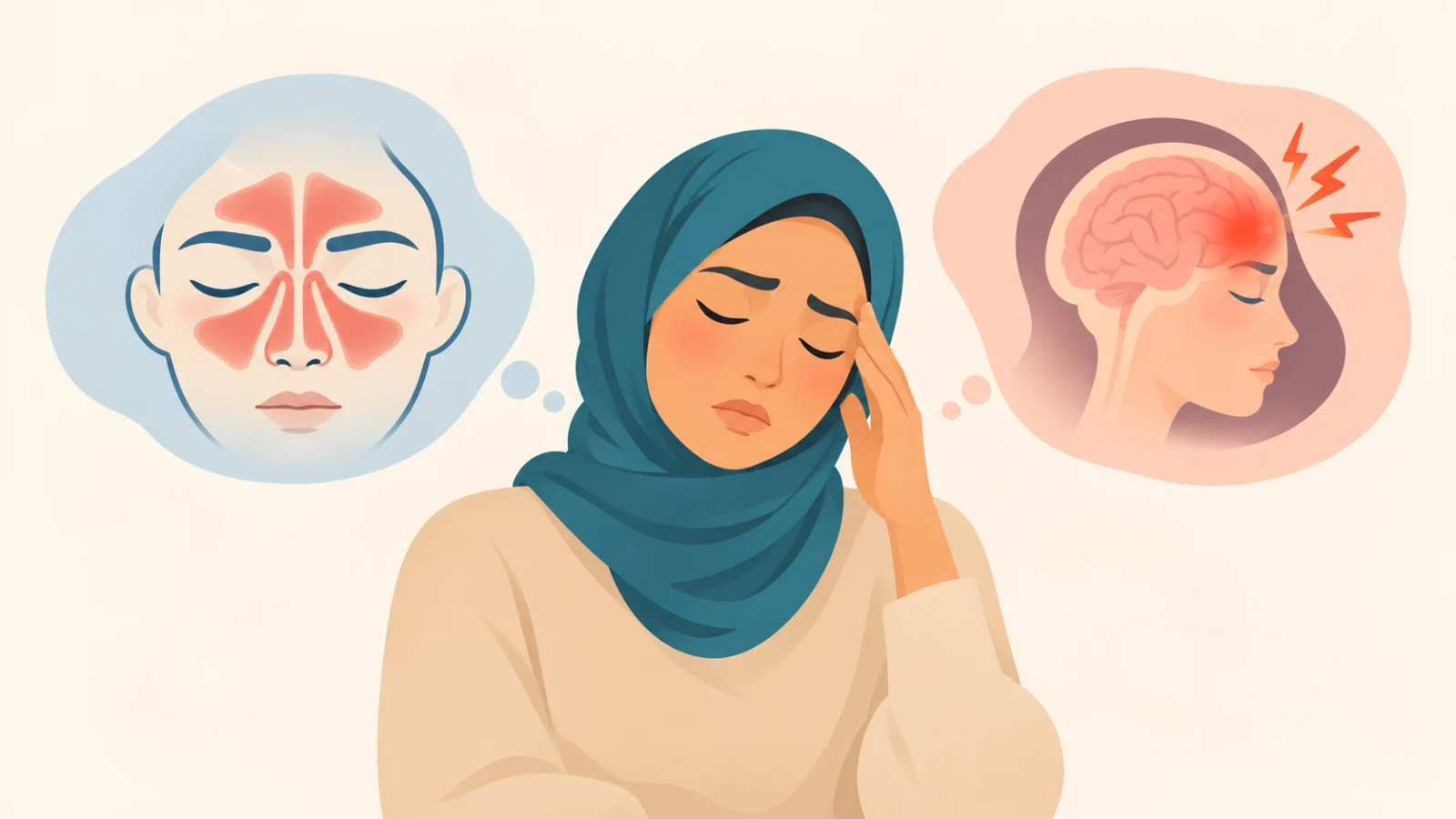
Sinus Headache or Migraine? Why They're Confused and How to Tell Them Apart
Your forehead feels heavy, your cheeks ache, your nose is blocked and your eyes are watering. Is it a sinus headache or migraine? It feels exactly like a sinus problem, so you reach for a decongestant and wait for it to pass. And yet it keeps coming back, every few weeks, with no cold in sight.
If that sounds familiar, you may be dealing with a sinus headache or migraine mix-up. It is one of the most common labels people put on their own head pain, and it is often wrong. This article explains why the two get confused, what a true sinus infection looks like, which clues point to migraine, and when it is worth getting checked. It sits alongside our guide to migraine symptoms, which covers the full picture of what an attack can involve.
In short
- About 90% of self-diagnosed sinus headaches turn out to be migraine, according to the American Migraine Foundation.
- Migraine itself can cause nasal congestion, a runny nose and watery eyes, which is why it so easily passes for a sinus problem.
- A true sinus infection usually comes with thick yellow or green mucus, fever and a changed sense of smell, and it follows a cold-like illness rather than returning in repeated attacks.
- Nausea, sensitivity to light and sound, and a throbbing, one-sided pain point towards migraine, and a doctor can help you sort it out.
Why do people confuse sinus headaches and migraines?
Because the two share a lot of symptoms, especially pressure in the face and a blocked nose. Migraine is not "just a headache": it is a neurological condition, and the same nerve pathways that carry pain from your head also run through your face and nose.
The numbers are striking. In a study of nearly 3,000 people who reported at least six "sinus headaches" in the previous six months, 88% turned out to have migraine, not sinus headache. The same page notes that 45% of people with migraine reported at least one symptom of nasal congestion or watery eyes during an attack.
The Cleveland Clinic puts it in plain terms: many people who have blamed their sinuses for years have migraine that was never recognised as such.
There is also a simple human reason. Pain around the eyes, cheeks and forehead sits exactly where your sinuses are, so "sinus" feels like the obvious explanation. Add a bit of pollen, a cold snap or a stuffy office, and the story seems to write itself.
How do you recognise a true sinus infection?
A sinus infection (sinusitis) usually shows up as facial pressure together with nasal symptoms and often a fever, and it tends to follow a cold. A sinus headache is not a separate disease: the Cleveland Clinic describes it as a symptom of sinusitis, often a constant, dull ache behind the eyes or in the cheekbones, forehead and bridge of the nose.
According to the Mayo Clinic, acute sinusitis often includes:
- thick yellow or greenish mucus from the nose or down the back of the throat
- a blocked or stuffy nose
- pain, tenderness, swelling and pressure around the eyes, cheeks, nose or forehead that gets worse when you bend over
- aching in the teeth, ear pressure, cough or bad breath
- a changed sense of smell
- tiredness and fever
The NHS lists a very similar set of signs: pain, swelling and tenderness around the cheeks, eyes or forehead, a blocked or runny nose, a reduced sense of smell, green or yellow mucus and a high temperature.
The key pattern is the "whole picture". A real sinus infection tends to arrive with a cold or an allergy flare, include fever or thick discoloured mucus, and then settle as the infection clears. It is not usually something that returns every month with no illness around it.
Which signs point more towards migraine?
Migraine is more likely when the pain is throbbing, comes in repeated attacks, and arrives with nausea or sensitivity to light and sound. The NHS describes the main symptoms as a throbbing headache, often on one side and worse when you move around, with feeling or being sick and being very sensitive to light and sounds.
The Cleveland Clinic adds that you may also feel really tired and be sensitive to smells. These features are not typical of a plain sinus infection.
Other clues that lean towards migraine:
- It comes in attacks. You feel fine, then the pain builds over hours, then it fades, and it happens again weeks later.
- The same triggers keep showing up. Stress, poor sleep, skipped meals, hormonal changes or a change in the weather often come before attacks. If you want to explore this, see how to identify your migraine triggers.
- There may be warning signs. Some people get visual changes, tingling or speech difficulties before the pain. This is called aura, and you can read more in our guide to migraine with aura.
- Your nose symptoms come and go with the pain. A runny or blocked nose that appears during the attack and vanishes afterwards is a classic migraine pattern, not an infection.
It is also worth knowing how long attacks last. The NHS says migraine attacks usually last between 4 hours and 3 days. If you want a closer look at timing, see how long a migraine lasts.
Sinus headache or migraine: a quick comparison
This table is a general guide, not a diagnosis, and real life is often messier. Many people have a mix of features, and some people have both a sinus problem and migraine.
| What you notice | More typical of a sinus infection | More typical of migraine |
|---|---|---|
| How it starts | After a cold or illness, with fever | Often with no illness, sometimes after a trigger |
| Mucus | Thick, yellow or green | Congestion or watery eyes may appear, but there is usually no infection |
| Pain feel | Constant dull ache or pressure in cheeks, forehead, behind the eyes | Often throbbing, can be on one side, worse with movement |
| Other symptoms | Fever, bad breath, toothache, reduced smell | Nausea, sensitivity to light, noise and smells |
| Pattern | One episode that settles as the infection clears | Repeated attacks over months or years |
| Duration | Usually follows the illness (see your doctor if it lasts beyond a week) | Usually 4 hours to 3 days per attack |
The sinusitis features come from the Mayo Clinic and the NHS, and the migraine features from the NHS migraine page and the American Migraine Foundation.
Can weather or allergies make it even harder to tell?
Yes. Weather changes and allergy seasons bring sinus-like symptoms and migraine triggers at the same time, so the two blur together. If your "sinus headache" appears when a storm rolls in, that may be a migraine reacting to the weather rather than a sinus problem.
Changes in atmospheric pressure are a well-discussed trigger, although the research is mixed. We look at the evidence in barometric pressure and migraines. The Cleveland Clinic also has a page on whether weather can trigger headaches or migraines.
The practical tip: do not treat each symptom in isolation. Notice what else is happening: what the weather did, how you slept, where you are in your cycle, and how stressed you have been.
What can you do to get a clearer answer?
The most useful step is to track your attacks for a few weeks and bring the notes to a doctor. A pattern of repeated episodes, with the same triggers and the same companion symptoms, is much more informative than a single bad day.
Here is what is worth writing down each time:
- When it started and how long it lasted.
- Where the pain was, and whether it was one-sided or throbbing.
- What came with it: nausea, light or sound sensitivity, fever, thick mucus.
- What happened beforehand: a cold, poor sleep, stress, a skipped meal, a period.
- What the weather was doing.
Our guide to what to write in a migraine diary goes into more detail. If you are also unsure whether what you have counts as a migraine at all, migraine vs headache explains the difference.
Why does it matter? Because the label shapes the treatment. Most sinus infections clear up without antibiotics, and they do nothing for migraine. Only a healthcare professional can tell you which one you are dealing with and what to do about it.
When should you see a doctor?
See a doctor if your "sinus headaches" keep coming back, if they do not respond to what you have tried, or if you are not sure what is going on. A GP or primary care doctor is a good place to start, and a pharmacist can also give advice for symptoms that look like sinusitis.
For a likely sinus infection, the NHS advises seeing a GP if you do not get better after 7 days of treatment from a pharmacy or GP, if you do not get better after 3 weeks of treating symptoms yourself, if you keep getting sinusitis, or if it is a child aged 11 or younger. The Mayo Clinic also suggests contacting a provider if symptoms last more than a week, get worse after seeming to improve, or come with a fever that lasts.
Get urgent help if you have:
- pain, swelling or redness around the eyes
- a high fever
- confusion
- double vision or other vision changes
- a stiff neck
The Mayo Clinic lists these as possible signs of a serious infection. For migraine-specific red flags, see when to go to the ER for a migraine.
If your headaches are happening very often, why you might have a headache every day is a good next read.
Not every pressure in the face comes from your nose
Facial pressure, a blocked nose and watery eyes can all be part of a migraine. A true sinus infection exists, but it is far less common than people think, and it usually comes with fever, thick mucus and a recent cold.
If your "sinus headaches" come in attacks, with nausea or sensitivity to light, and keep returning without an infection, migraine is worth raising with your doctor. Keeping a simple record of your attacks will make that conversation much easier. You do not have to figure it out alone, and getting the right label is often the first step towards feeling better.
Frequently asked questions
Is a sinus migraine a real thing?
"Sinus migraine" is a popular name, not a separate diagnosis. It usually describes a migraine that comes with nasal congestion or facial pressure. The American Migraine Foundation notes that many people with migraine have nasal symptoms such as congestion or watery eyes during an attack.
How can I tell if my headache is from sinus pressure or migraine?
Look at the whole pattern, not just the pain location. Fever, thick yellow or green mucus and a recent cold suggest a sinus infection, according to the Mayo Clinic. Repeated throbbing attacks with nausea or sensitivity to light and sound point more towards migraine, as described by the NHS.
Can you have a sinus infection and a migraine at the same time?
Yes, it is possible to have both, since a sinus infection can happen to anyone, including people who live with migraine. This is one reason a doctor's assessment is useful if your symptoms are mixed or do not fit a clear pattern.
Do sinus headaches get worse when you bend over?
They can. The Mayo Clinic lists facial pain and pressure that gets worse when bending over as a sign of acute sinusitis. Migraine pain, in contrast, is often described as worse with movement in general, according to the NHS.
Will a decongestant or antibiotic help a migraine?
Treatments aimed at the sinuses are not designed for migraine, so they often do not help when the real cause is migraine. A doctor can explain which options make sense for you after working out what is causing your symptoms.
Sources
- Migraine vs. Sinus Headache: What's the Difference?
- Sinus Headaches: Symptoms, Causes & Relief
- Migraine: What It Is, Types, Causes, Symptoms & Treatments
- Barometric Pressure Headache: Can Weather Trigger Headaches or Migraines?
- Acute sinusitis - Symptoms and causes - Mayo Clinic
- Sinus Infections · Most Clear Up without Antibiotics - Mayo Clinic News Network
- www.nhs.uk
- Migraine - NHS
Written by Laurine Nicoletti, founder of Mellow, who has lived with migraine since she was 21. Learn more · How we write our articles
Related articles

Types of Migraine: A Simple Map of the Main Forms
Types of migraine explained simply: with aura, without aura, episodic, chronic, vestibular and rare forms, plus links to each detailed guide.

Migraine Without Aura: Symptoms, Duration and How It Differs From Migraine With Aura
Migraine without aura is the most common type of migraine. Learn the symptoms, how long it lasts and how it differs from migraine with aura in plain words.

Menstrual Migraine: When Periods Trigger Migraine Attacks
Menstrual migraine explained: pure vs menstrually-related criteria, the estrogen drop behind attacks, and treatment options to discuss with your doctor.