
Migraine That Won't Go Away: Why It Lasts Days and When to Get Help
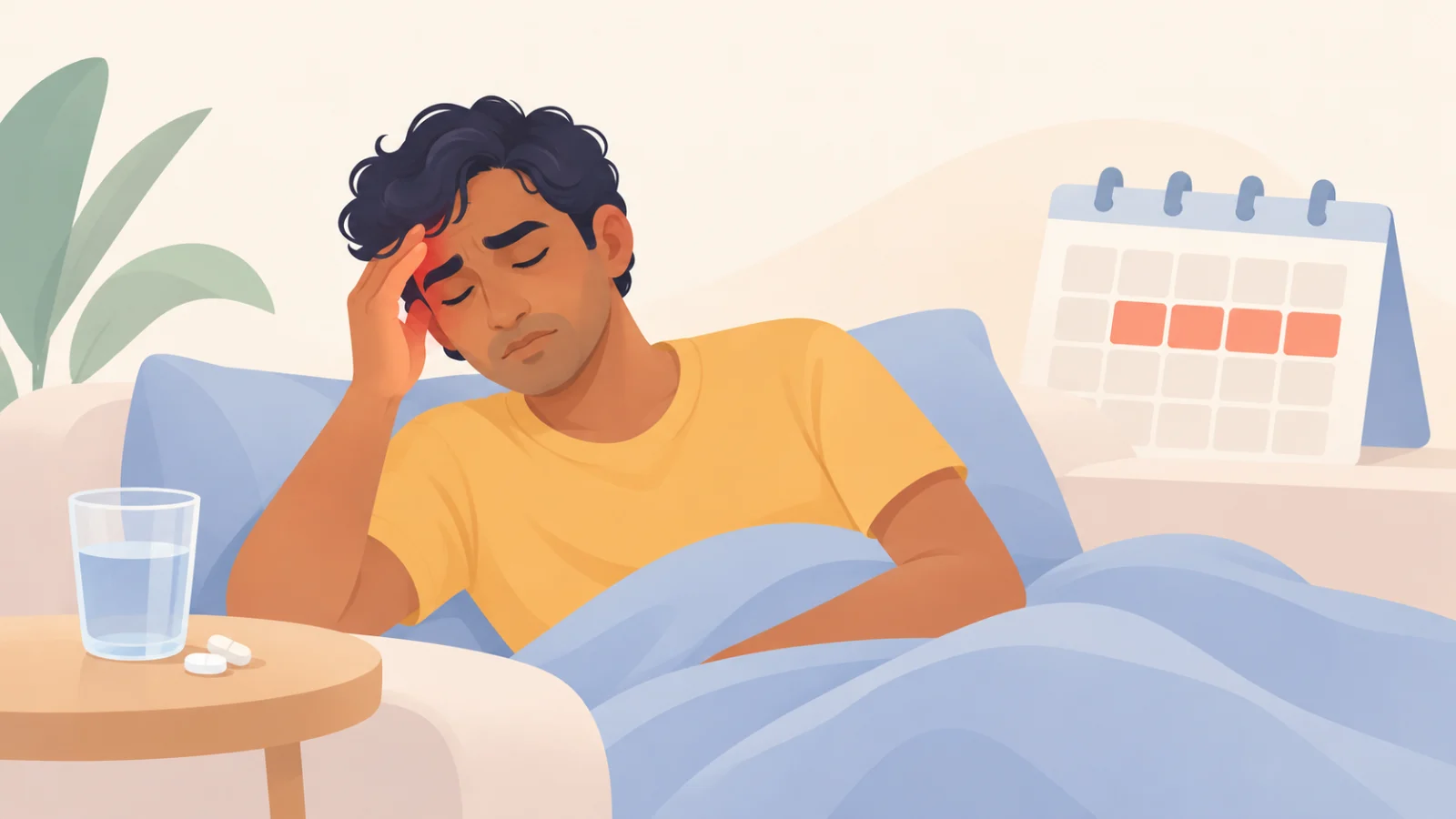
You woke up with a migraine on Monday. It is now Wednesday evening, and you have a migraine that won't go away: the pain has changed shape but it has not gone, and you are starting to wonder whether this is still "just a migraine".
A migraine that won't go away for more than three days has a name (status migrainosus), a handful of well-known explanations and clear guidance on when to ask for help. This article walks through all three, calmly. If you want the bigger picture first, our migraine symptoms guide is a good place to start.
In short
- A migraine headache typically lasts from 4 hours to 3 days, and one that runs past 72 hours without a pain-free break is called status migrainosus.
- Common reasons an attack drags on include stress, lack of sleep, skipped meals, changes in regular medication, treatment that is started late or is not the right fit, and painkillers used too often.
- The NHS advises an urgent GP appointment or a call to NHS 111 for a migraine lasting longer than 72 hours, and the American Migraine Foundation says status migrainosus calls for emergency care.
- A sudden, explosive headache, fever with a stiff neck, confusion, or weakness on one side of the body is an emergency whatever the duration.
How long is a migraine supposed to last?
The headache phase of a migraine typically lasts from four hours to three days, according to the American Migraine Foundation. The NHS gives the same range for migraine symptoms.
The whole attack is longer than the headache. Counting the warning phase before the pain and the "hangover" phase after it, an attack may last from a bit more than one day to slightly more than a week at its very longest, and the foundation notes that this is not typical. Most attacks last one to two days.
That hangover phase (called postdrome) is worth knowing about. It affects around 80% of people with migraine, usually lasts one to two days, and can bring fatigue, trouble concentrating, dizziness and sensitivity to light, as the American Migraine Foundation explains. So some of those "still there" days may be the tail end of an attack rather than the pain itself.
For a fuller timeline, see how long a migraine lasts.
What is status migrainosus?
Status migrainosus is a migraine attack that lasts longer than 72 hours, according to Cleveland Clinic. It feels like your usual migraine (throbbing pain, light sensitivity, nausea), only longer and often more intense.
The key detail is that the pain does not stop. The American Migraine Foundation describes it as a migraine lasting more than 72 hours without a pain-free interval. If the pain eases for a few hours when you sleep or after medication and then comes back, that is a different pattern, though still worth mentioning to your doctor.
It is also not the same thing as chronic migraine. Chronic migraine means 15 or more headache days a month, while status migrainosus is a single, continuous attack.
Status migrainosus is not the usual migraine experience, but it is well recognised and treatable. The point of knowing the term is simply that you can recognise it early and ask for help sooner.
Why a migraine won't go away: the usual suspects
There is rarely one single reason. Researchers do not fully understand why an individual attack turns into a prolonged one, and the American Migraine Foundation says the exact reason is not known. What they do see are some recurring patterns.
Triggers stacking up
A trigger or a combination of triggers can push an attack into a longer one. The American Migraine Foundation lists changes in medication, skipped meals, lack of sleep and stress, and Cleveland Clinic names the same group as the most common events.
Pain itself makes this worse. When you are in pain you sleep badly, eat irregularly and feel tense, which are the very things that feed the next wave. Our guides on migraine and sleep and stress and migraines go deeper on each one.
Treatment started late or not a good fit
Painkillers tend to work best when taken at the first signs of an attack, because they need time to be absorbed. The NHS notes that waiting until the headache worsens is often too late for the medicine to work.
Cleveland Clinic also points out that a major contributor to a migraine lasting longer than three days is a current treatment plan that is not the right fit for your body. That is not a failure on your side. It is a signal that the plan may need a review with your doctor. If you have been prescribed triptans, our guide to how triptans work explains the basics.
Painkillers used too often
Taking pain relievers frequently can, paradoxically, keep headaches going. Mayo Clinic explains that medication overuse headaches tend to happen every day or nearly every day, improve with pain medicine, then return as it wears off.
Cleveland Clinic's general rule is to keep over-the-counter headache medicines to two days a week or fewer to reduce the risk of rebound headaches. It also says that using headache medicines every day or almost every day may change how parts of your brain process pain.
This is the "cycle of pain" many people recognise: an attack, a painkiller, relief that fades, a headache that returns, another painkiller. If this sounds familiar, do not stop or change anything on your own. This is something to raise with your doctor or pharmacist, who can help you step out of the cycle safely.
Hormones
If your long attacks cluster around your period, hormones may be part of the story. In one prospective study of women with menstrual migraine, menstrual attacks were more painful and lasted about 11 hours longer than their non-menstrual attacks. You can read more in our guides to menstrual migraine and migraine and periods.
Is it really a migraine?
A headache that lasts for days is not always a migraine, and only a doctor can tell you what you are dealing with. Long-lasting pain can come from other headache types, from medication overuse headache, or occasionally from something that has nothing to do with migraine.
A few questions can help you sort it out before an appointment:
- Does it feel like your usual migraine, with the same throbbing, nausea and light sensitivity, just longer?
- Or is it a different kind of pain, in a different place, or with symptoms you have never had?
- Did something new happen recently, such as a head injury or an infection? Cleveland Clinic notes that status migrainosus is seen after a head injury and some viral infections.
If your headaches are close to daily rather than one long attack, our article on why you might have a headache every day covers that pattern. For the basics of telling the two apart, see migraine vs headache.
What can help while the attack drags on
While you wait for a medical review, gentle basics are reasonable. The NHS says most people find that sleeping or lying in a quiet, darkened room is the best thing to do during an attack.
Beyond that, a few things are worth keeping in mind:
- Keep a simple note of what you have taken and when. It helps you avoid slipping into overuse without noticing, and it is exactly what a doctor will ask.
- Be careful with escalating painkillers. The NHS warns that regularly using painkillers at the top of what is allowed could make headaches harder to treat over time.
- Ask a pharmacist or doctor what is safe for you rather than guessing, especially if you are already taking migraine medication.
- Try non-drug comfort measures alongside your usual plan. Our guide on relieving a migraine without medication lists options with an honest note on the evidence.
What doctors can do when a migraine will not settle is also reassuring to know. Cleveland Clinic says treatment in an emergency department can include IV medicines for pain control and nausea, plus IV fluids for dehydration after prolonged vomiting. The American Migraine Foundation adds that dihydroergotamine (DHE), available as a nasal spray, injection or infusion, is often effective for severe or prolonged migraines. Which option suits you is always your clinician's decision.
When to get medical help for a migraine that lasts days
If your migraine has lasted longer than 72 hours, get medical advice rather than waiting it out. The NHS says to ask for an urgent GP appointment or get help from NHS 111 for a migraine that has lasted longer than 72 hours, or if aura symptoms last longer than an hour at a time.
In the United States, the American Migraine Foundation is more direct: with a continuous migraine for 72 hours, you need to go to the emergency room. It also recommends talking to your provider ahead of time about a plan for when an attack passes the 72-hour mark.
Call emergency services if the headache is different
Some symptoms are an emergency whatever the duration. The NHS lists these as reasons to call 999: a headache that comes on suddenly and is extremely painful, problems speaking or remembering, loss of vision or double vision, drowsiness or confusion, a seizure, a very high temperature with symptoms of meningitis, or weakness on one side of the body or face.
Mayo Clinic gives a similar list for the US, including the worst headache of your life, a stiff neck, fever, numbness or trouble speaking. Our guide on when to go to the ER for a migraine puts this into a quick checklist.
Book a regular appointment if the pattern is changing
You do not need to wait for a 72-hour attack to talk to someone. The NHS suggests seeing a GP if your migraines are severe, getting worse, lasting longer than usual, or happening more than once a week. It also says that migraines on more than 5 days a month are worth a visit, even if medicine controls them, because preventive treatment may help.
How to prepare for your appointment
Doctors can only work with what you can tell them, and during a long attack your memory gets foggy. A few notes written as you go make the visit far more useful.
Try to capture:
- When the attack started and whether the pain has ever fully stopped.
- How it differs from your usual migraine (location, intensity, new symptoms).
- Which medicines you took, on which days, and how many days a month you take them.
- Sleep, meals, stress, your cycle and any new medication in the days before.
- Any recent head injury, infection or other change.
Our guide on what to write in a migraine diary goes into more detail. If you track in Mellow, the history and the report for your doctor already hold most of this, so you do not have to rebuild it from memory in the waiting room.
A long attack does not mean it will always be like this
Having one migraine that lasts days does not mean every attack from now on will. For many people it is a one-off linked to a particular stretch of poor sleep, stress, a missed treatment or a hormonal shift.
What a long attack does give you is information. It shows you which triggers piled up, whether your treatment worked, and whether painkillers have crept into too many days of the month. With your doctor, that information can turn into a plan for the next attack, and a plan is the best protection against a repeat.
If you are in the middle of one right now and it has passed the 72-hour mark, please do not wait. Call your GP or NHS 111, or head to urgent care or the ER if you are in the US. You deserve relief sooner, not tougher endurance.
Frequently asked questions
Can a migraine last 4 or 5 days?
Yes, it can, although it is not typical. The American Migraine Foundation says a full attack, including the warning and recovery phases, can last from a bit more than a day to slightly more than a week at its very longest. If the headache itself has been constant for more than 72 hours, medical advice is recommended.
Is a migraine that lasts 3 days dangerous?
Most prolonged migraines are not life-threatening, but they should not be ignored. The NHS recommends an urgent GP appointment or a call to NHS 111 once a migraine passes 72 hours. Sudden, severe onset or symptoms such as confusion, fever with a stiff neck, or weakness need emergency care.
Can painkillers make a migraine last longer?
They can when used too often. Mayo Clinic explains that medication overuse headaches improve with pain medicine and then return as it wears off, which can keep headaches going almost daily. Your doctor or pharmacist can help you review how often you take them.
Is status migrainosus the same as chronic migraine?
No. Chronic migraine means 15 or more headache days a month, while status migrainosus is one continuous attack lasting 72 hours or longer. Someone can have one without the other, so tell your doctor about both how often and how long your attacks run.
Sources
- How Long Does a Migraine Attack Last?
- What Is Status Migrainosus?
- Dihydroergotamine (DHE) for Migraine Treatment
- Cleveland Clinic logo
- Headache Medicine: Relief, Management, OTC & Prescription
- Migraine - NHS
- Migraine - Symptoms - NHS
- Migraine - Treatment - NHS
- www.nhs.uk
- Medication overuse headaches - Symptoms and causes - Mayo Clinic
- Headache - Causes and definition - Mayo Clinic
- EHMTI-0230. Characteristics of menstrual and nonmenstrual migraine attacks in women with menstrual migraine
Written by Laurine Nicoletti, founder of Mellow, who has lived with migraine since she was 21. Learn more · How we write our articles
Related articles

Types of Migraine: A Simple Map of the Main Forms
Types of migraine explained simply: with aura, without aura, episodic, chronic, vestibular and rare forms, plus links to each detailed guide.

Migraine Without Aura: Symptoms, Duration and How It Differs From Migraine With Aura
Migraine without aura is the most common type of migraine. Learn the symptoms, how long it lasts and how it differs from migraine with aura in plain words.

Menstrual Migraine: When Periods Trigger Migraine Attacks
Menstrual migraine explained: pure vs menstrually-related criteria, the estrogen drop behind attacks, and treatment options to discuss with your doctor.