
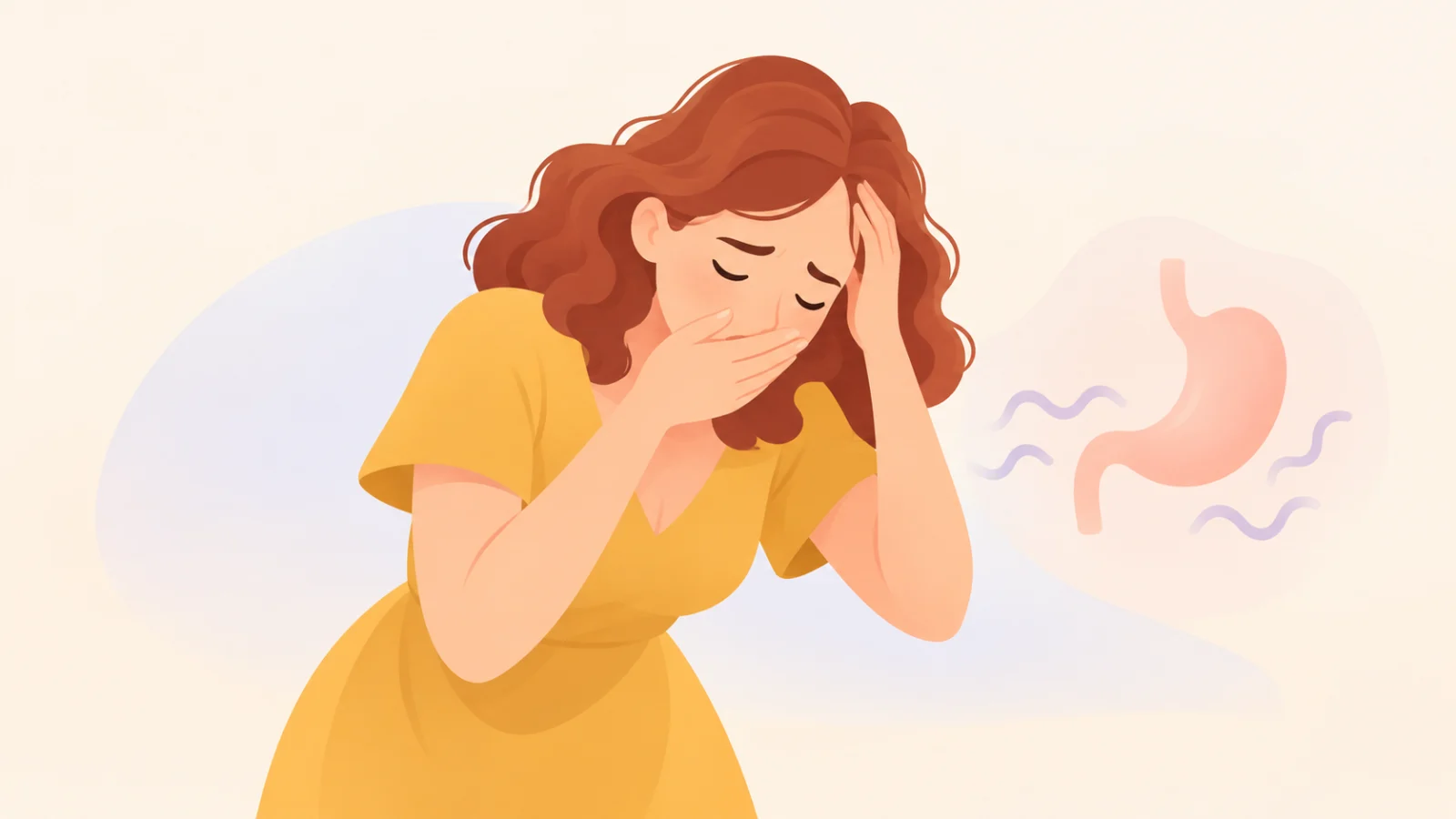
Migraine Nausea: Why It Happens and How to Ease It
You feel the headache building, and then your stomach joins in. Maybe the smell of coffee suddenly turns your stomach, or you end up on the bathroom floor wondering whether you can face even a sip of water. Migraine nausea is one of the most common (and most miserable) parts of an attack, and it has nothing to do with being dramatic or with having eaten the wrong thing.
In this article you will see why migraine and your digestion are so closely linked, when nausea tends to appear during an attack, why tablets sometimes seem to stop working, and which simple gestures can take the edge off. For the wider picture of what exists to treat and prevent attacks, you can also read our guide to migraine treatments.
In short
- Migraine nausea is very common: a large US study found that headache-related nausea occurs in about 80% of people with migraine.
- One main cause is that the stomach slows down during an attack (gastric stasis), which can cause nausea and vomiting and also make oral medication absorb less well.
- Nausea can show up before the pain, during it, and again in the recovery phase afterwards, according to the American Migraine Foundation and the Cleveland Clinic.
- Fresh air, small sips of cold drinks, ginger or peppermint tea and a dark, quiet room may help, and a doctor can discuss anti-sickness medicines or non-oral forms of treatment.
Why does migraine nausea happen?
Migraine nausea happens because an attack affects more than your head: it also changes how your nervous system controls your stomach. The NHS lists feeling or being sick as one of the main symptoms of a migraine attack, alongside throbbing pain and sensitivity to light and sound.
It is also very common. In the American Migraine Prevalence and Prevention study, about 80% of people with migraine had nausea with their headaches, and among people with episodic migraine, 49.5% had it at least half the time. Frequent nausea was more common in women than in men (adjusted odds ratio of 1.35 in the same study).
A stomach that slows down
Part of the explanation is gastric stasis, which simply means the stomach empties more slowly than it should. The National Headache Foundation explains that when the stomach stops contracting, it can cause nausea and vomiting. Doctors believe migraine interferes with the nerve signals that tell the muscles of the stomach and intestines to move.
Serotonin, a chemical messenger, is also thought to play a part. A research summary from the American Headache Society notes that serotonin signalling is especially relevant to the nausea, vomiting and changes in gastric emptying that can accompany migraine, and that the gut contains most of the body's serotonin.
Why it matters beyond the discomfort
Nausea is not just an unpleasant extra. In the same US study, people with frequent nausea reported more headache-related impact on their daily life, and the researchers concluded that nausea makes an independent contribution to migraine-related disability. That is a good reason to mention it to your doctor, not to just put up with it.
When in an attack does the nausea show up?
Nausea can appear at several points of an attack: before the headache, during it, and sometimes afterwards. Your own pattern may be quite different from someone else's.
- Before the pain (prodrome). The American Migraine Foundation describes the prodrome as a phase that can last hours or even days before a headache starts, with symptoms such as mood changes, fatigue, insomnia and nausea.
- During the headache. Nausea is one of the common symptoms of the headache phase, often together with sensitivity to light and sound.
- Afterwards (postdrome). The Cleveland Clinic lists nausea among the postdrome symptoms, along with tiredness, dizziness and trouble concentrating.
If you want to know how long each phase can last, our article on how long a migraine lasts goes through them one by one.
Noticing when your nausea starts is more useful than it sounds. It affects when you might be able to take something, and it is exactly the kind of detail a doctor will want to hear.
Why does your medication sometimes work less well when you feel sick?
Medication can work less well during an attack because a slow stomach delays how quickly a tablet gets absorbed. The National Headache Foundation notes that delayed gastric emptying can impair the absorption of oral medications and reduce how well they work. If you vomit, you may also simply not keep the tablet down.
This is why timing matters. The NHS says painkillers tend to be most effective if taken at the first signs of a migraine attack, before the stomach has really slowed down. Waiting until you feel very sick often makes things harder.
Forms that do not rely on your stomach
For people with digestive symptoms, the American Headache Society explains that its guidelines recommend non-oral therapies for patients with gastrointestinal symptoms. The NHS mentions that if you cannot swallow painkillers because of nausea or vomiting, suppositories may be a better option. Some triptans also exist as nasal sprays.
Which form suits you, if any, is a decision for you and your doctor or pharmacist. If you would like to understand how triptans work before that conversation, see Triptans Explained: Types, Side Effects and Safety.
Which simple gestures can ease migraine nausea without medication?
A few gentle gestures can take the edge off nausea, even though they will not stop the attack itself. They are not a cure and they do not replace medical advice, but they cost nothing and carry little risk.
The NHS offers a list of things that may help when you feel sick, and most of them fit a migraine day well. According to its guidance on feeling sick, you can try to:
- get plenty of fresh air;
- distract yourself, for example with music (a bright screen may be too much during a migraine);
- take regular sips of a cold drink;
- drink ginger or peppermint tea, or eat foods containing ginger such as ginger biscuits;
- eat smaller, more frequent meals when you feel able to eat.
The same page suggests avoiding strong-smelling food, hot or greasy food, eating too quickly, and tight clothing around your waist or tummy. For the migraine itself, the NHS says that sleeping or lying in a darkened room is what most people find best during an attack.
What do studies say about ginger, peppermint and acupressure?
The evidence is encouraging but small, so it is worth being honest about it. A meta-analysis of three randomised trials found that ginger reduced the risk of migraine-related nausea and vomiting compared with a placebo (risk ratio 0.48). The same review stresses that the evidence base is too small to support ginger as a first-line treatment, and one trial found it no better than placebo for preventing attacks.
For peppermint, a small 2020 study suggested peppermint oil may help reduce nausea and vomiting. Acupressure on the P6 (Neiguan) point, on the inside of the wrist, is also described as something that may help with nausea linked to migraine. Think of these as gentle things to try, not proven fixes.
For more ideas that do not involve pills, see How to Relieve a Migraine Without Medication. And if you suspect that certain foods or skipped meals are part of your pattern, Migraine and Food explains what is known about triggers.
What can your doctor offer for migraine nausea?
Your doctor can discuss anti-sickness medicines (antiemetics), which are a recognised part of migraine treatment. The NHS lists medicines that stop you feeling sick or being sick among the treatments for migraine attack symptoms, next to painkillers, triptans and gepants.
According to the NHS treatment page, these medicines are prescribed by a GP and can be taken alongside painkillers and triptans. They work better when taken as soon as migraine symptoms begin, and they usually come as tablets but also as suppositories. Possible side effects include drowsiness and diarrhoea. The NHS adds that anti-sickness medicines can help treat migraine in some people even if they do not feel or are not sick, and that some combination products containing both a painkiller and an anti-sickness medicine are available at pharmacies.
What you take, in which form and when is always a personal decision to make with a healthcare professional. It helps to arrive with a few simple notes:
- when the nausea starts in your attacks (before, during or after the pain);
- whether you actually vomit;
- whether tablets seem to stay down and work, or not;
- how often attacks happen.
For the full overview of acute and preventive options, our page on migraine treatments is a good place to start.
When should you get help?
Get help if you keep vomiting and cannot keep fluids down, or if your headache or symptoms feel different from your usual attacks. Repeated vomiting can lead to dehydration, which is easy to miss when you already feel awful.
The NHS gives clear guidance on vomiting. It advises people to call 111 if they keep being sick and cannot keep fluid down, and lists the signs of dehydration: feeling thirsty, light-headed or dizzy, dark yellow strong-smelling pee, peeing less often, feeling tired and having a dry mouth. It also says to call 999 or go to A&E if you have a stiff neck and pain when looking at bright lights, or a sudden severe headache. Outside the UK, contact your doctor, urgent care or local emergency number in the same situations.
Outside of emergencies, the NHS advises seeing a GP if you often feel sick, or if the feeling keeps coming back. If your migraines are long-lasting, our article on a migraine that won't go away explains when to ask for help.
Nausea is part of migraine, and you do not have to just endure it
Migraine nausea is common, it has real biological causes, and there are things you can do about it. A slowed stomach explains both the queasiness and why a tablet can fail to work when you need it most.
A practical way to approach it:
- Notice your pattern. Does nausea come before the pain, with it, or after?
- Keep easy comforts within reach. Cold water, ginger or peppermint tea, fresh air and a dark room.
- Talk about timing and form. Ask your doctor or pharmacist what could work when swallowing a tablet is hard.
- Do not wait to be dehydrated. Small, regular sips count, and urgent signs deserve prompt help.
None of this is about perfection. A bad migraine day is still a bad day, and getting through it a little more gently is a real win.
Frequently asked questions
Why do I feel sick before my headache even starts?
Nausea can be part of the prodrome, the early phase of a migraine. The American Migraine Foundation says this phase can start hours or even days before the headache and may include fatigue, mood changes and nausea. Not everyone has it, but for some people it is an early warning sign.
Does nausea mean my migraine is more severe?
Not necessarily, but frequent nausea is linked with a heavier burden. In a large US study, people who often had nausea with their headaches reported significantly more headache-related impact. This is an association, so it is a good reason to tell your doctor rather than a sign that something is wrong with you.
What can I eat or drink when I have a migraine and feel sick?
The NHS suggests regular sips of a cold drink, ginger or peppermint tea, and smaller, more frequent meals when you feel sick. It also suggests avoiding strong-smelling, hot, fried or greasy food. If you cannot face food at all, focus on small sips of fluid.
Is ginger really good for migraine nausea?
It may help, but the evidence is limited. A review of three randomised trials found that ginger lowered the risk of migraine-related nausea and vomiting compared with placebo, while noting that the evidence is too small for formal recommendations. It is a reasonable, low-risk thing to try, but not a substitute for medical advice.
Can I take something for nausea together with my usual migraine medicine?
Ask your doctor or pharmacist, because it depends on you. The NHS says anti-sickness medicines prescribed by a GP can be taken alongside painkillers and triptans, but the right choice and timing should be decided with a healthcare professional.
Sources
- frequency and burden of headache related nausea results from the 2
- understanding nausea and vomiting with migraine
- Headache Journal
- Webinar Recap: The Phases of Migraine
- Oral & Intranasal Triptans for Migraine
- Cleveland Clinic logo
- www.nhs.uk
- www.nhs.uk
- feeling sick nausea
- Diarrhoea and vomiting - NHS
- ginger effective migraine
- Key takeaways
Written by Laurine Nicoletti, founder of Mellow, who has lived with migraine since she was 21. Learn more · How we write our articles
Related articles

Botox for Chronic Migraine: The PREEMPT Protocol Explained
Botox for chronic migraine explained: the PREEMPT protocol, who is eligible, injection sites, side effects and insurance coverage. An evidence-based guide.

Magnesium for Migraine: Science-Backed Prevention Guide
Which form of magnesium for migraine prevention? Glycinate, citrate or oxide, the dose studied and how long to wait for results. A complete guide.

CGRP Inhibitors for Migraine Prevention: A Complete Guide
Anti-CGRP medications for migraine: how Aimovig, Ajovy, Emgality and Vyepti work, how effective they are, side effects, who qualifies and costs.