Tension Headache Symptoms: Duration and How It Differs From Migraine
You get to the end of a long day and your head feels squeezed, as if you're wearing a hat that's two sizes too small. Your neck and shoulders are tight, but you're not nauseous, and light doesn't bother you. Are these tension headache symptoms, a migraine, or something else?
What you're describing could well be a tension headache (also called a tension-type headache). It's the most familiar kind of headache, and it's different from a migraine in a few useful ways. This article explains the usual tension headache symptoms, how long they last, how to tell them apart from migraine, and why many people have both. It can't diagnose you, but it can give you words and clues to bring to a doctor. For the bigger picture, our migraine diagnosis guide walks through how headaches get sorted out.
In short
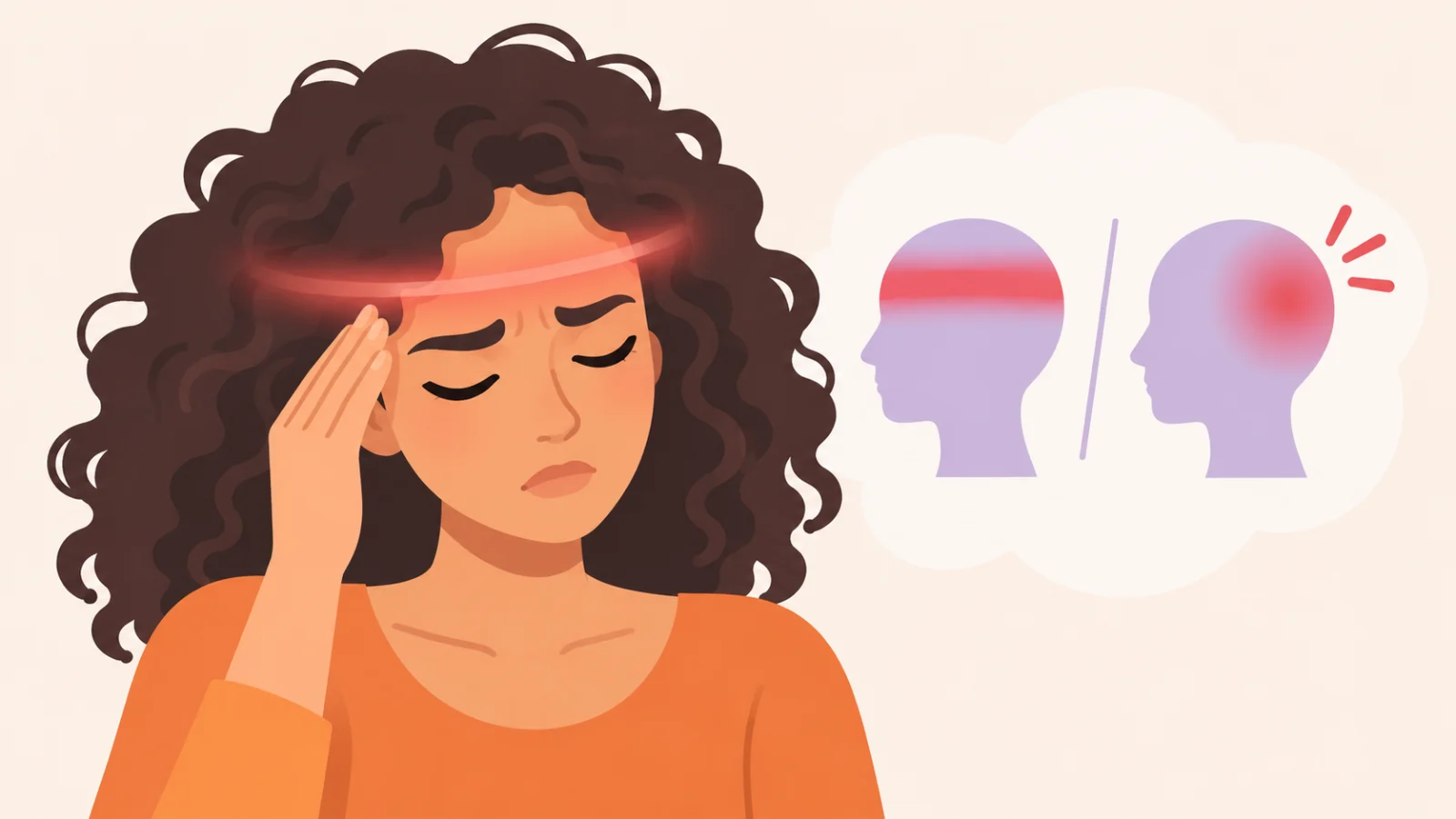
- A tension headache is usually a dull, pressing pain on both sides of the head, often described as a tight band, and it's typically mild to moderate.
- It can last from about 30 minutes to several days, and it usually doesn't come with nausea or get worse when you move.
- Migraine is more often throbbing, moderate to severe, and comes with nausea or sensitivity to light and sound.
- You can have both tension-type headaches and migraine, so a pattern that looks "mixed" is common and worth discussing with a doctor.
What is a tension headache?
A tension headache is a common primary headache, meaning the headache is the condition itself rather than a symptom of another illness. The World Health Organization lists tension-type headache alongside migraine and cluster headache as the main primary headache disorders. It describes the pain as pressure or tightness, often like a band around the head, sometimes spreading into or from the neck.
The name suggests it's all about stress, but that's only part of the story. The Mayo Clinic explains that these headaches cause mild to moderate pain, and that many people get them now and then without much trouble. Others get them often enough that they affect their days.
What are the symptoms of a tension headache?
The classic tension headache feels like a constant, dull pressure on both sides of the head, rather than a pulse or a stab. The NHS describes pain on both sides of the head, face or neck, and a feeling of something pressing on or tightening around your head. The area can feel tender, and your head may hurt more when touched.
Typical signs include:
- A band-like or "helmet" pressure around the forehead, temples or the back of the head
- Mild to moderate pain that doesn't usually stop you from carrying on, even if it's annoying
- Tight, achy muscles in the neck, shoulders or scalp
- Pain that may build up as the day goes on, according to the NHS
Just as telling is what's usually missing. The Mayo Clinic notes that tension headaches don't usually cause nausea or vomiting, and don't bring the visual disturbances (like flashing lights or bright spots) that some migraines do. If you often see zigzags or sparkles before your head hurts, our guide to migraine with aura is a better place to start.
How long does a tension headache last?
A tension headache lasts from about 30 minutes to several days. The NHS says it lasts at least 30 minutes but can last much longer, and the Mayo Clinic describes episodes that can run from half an hour to about a week.
How often they happen matters as much as how long each one lasts. The Cleveland Clinic groups tension headaches like this:
- Infrequent episodic: one day a month or fewer
- Frequent episodic: one to 14 headaches a month for at least three months
- Chronic: more than 15 headaches a month for three months
If your head hurts most days, that's worth a proper conversation with a doctor, whatever the label. Our article on why you might have a headache every day explains the main possibilities and what clinicians look at.
Tension headache vs migraine: how can you tell the difference?
The clearest differences are the type of pain, how severe it is, and the other symptoms that come with it. Tension headaches tend to be dull, pressing, mild to moderate and on both sides. Migraines are more often throbbing, moderate to severe, and bring extra symptoms.
According to the American Migraine Foundation, tension-type headaches tend to cause mild to moderate pain on both sides of the head, while migraines are usually moderate to severe, pulsating, and can bring nausea, vomiting or increased sensitivity to light or sound. The same source adds that light and sound sensitivity can still happen with a tension-type headache, but usually only one of the two, not both together.
Here's a simple side-by-side:
| Tension headache | Migraine | |
|---|---|---|
| Pain feel | Dull, pressing, tight band | Often throbbing or pulsing |
| Intensity | Mild to moderate | Moderate to severe |
| Location | Usually both sides | Often one side, but not always |
| Nausea or vomiting | Not usually | Common |
| Light and sound sensitivity | Sometimes one of them | Often both |
| Aura (visual or other signs) | No | Possible |
| Effect of movement | Usually no change | Often worse with activity |
On movement, the Mayo Clinic points out that physical activity tends to make migraine pain worse, while it doesn't typically affect tension-type headache pain. A useful question to ask yourself is: "Could I still climb the stairs or go for a walk?" If the answer is no, because every step hurts, that leans toward migraine. For a deeper comparison, see migraine vs headache and our map of the main types of migraine.
One caveat: these are patterns, not rules. Migraine can be milder than you'd expect, and a tension headache can be unpleasant. Only a clinician who knows your history can say which is which.
Why do tension headaches happen?
Nobody knows exactly why tension headaches happen. The old explanation was simply that tight head and neck muscles cause the pain, but research suggests it's more complicated than that.
Studies have found that tenderness in the muscles around the skull is the most noticeable finding in tension-type headache. Researchers writing in the journal The Journal of Headache and Pain note that the exact mechanisms are still unclear, and that the tenderness may reflect how pain is processed by the nervous system rather than a problem in the muscle itself. So "tight muscles" is part of the picture, not the whole explanation.
What people commonly report as triggers is more concrete. The Cleveland Clinic groups them into muscle tightness, emotional stress, environmental factors and lack of sleep, and says that the mental load of work and family can show up as tension in the neck and shoulders. If stress is a big part of your life, our article on stress and migraines looks at the vicious cycle between the two.
Neck tension is also a common source of confusion, because migraine can start in the neck too. Our guide to migraine neck pain explains how to read that overlap.
Can you have tension headaches and migraine at the same time?
Yes, many people have both, and it's one reason headaches can be hard to label. Research describes tension-type headache and migraine as highly overlapping in daily life, with many people experiencing both. A paper titled Tension type headache is dead; long live chronic migraine! even argues that some headaches called tension-type may be milder forms of migraine, which shows how blurry the line can be.
There are a few ways this can look in real life:
- You have clear migraine attacks a few times a month, plus duller "band" headaches on stressful days.
- Your attacks start as a tight neck and pressure, then turn into full migraine with nausea.
- Your headaches shift between the two patterns, and it's hard to say which is which.
This is exactly why a headache diary helps. Writing down when it started, what it felt like, how strong it was and what came with it lets patterns show up that memory misses. Our guides on what to write down in a migraine diary and how to identify your triggers can help you get started.
What can you do if you recognise yourself in this?
If this sounds familiar, the most useful step is to track your headaches for a few weeks and talk to a doctor. A clinician can ask about your symptoms, your history and your daily life, and decide what's going on. That's something no article can do for you.
A few practical things can make that appointment more useful:
- Note how often headaches happen, how long they last and how strong they are
- Write down whether you had nausea, sensitivity to light or sound, or any visual changes
- Note what you were doing before: poor sleep, a stressful stretch, long hours at a screen
- Mention any medication you've taken and how often you take it
Our guide on when to see a doctor for migraine explains who to book and how to prepare.
Treatment depends on the type of headache, how often it happens and your health history, so please ask your doctor or pharmacist before starting or changing anything. If you're curious about how common medicines are used, migraine medication explains them in general terms.
When should you get help quickly?
Most tension headaches are not dangerous, but some symptoms need prompt attention. The NHS advises getting an urgent GP appointment or calling 111 if you have a severe headache along with jaw pain when eating, blurred or double vision, a sore scalp, or numbness or weakness in your arms or legs. In the US, the equivalent is to call your doctor or seek urgent care. Our article on when to go to the ER for a migraine lists the warning signs in more detail.
The Cleveland Clinic also recommends seeing a healthcare provider if your headaches feel different from usual, happen more often, or last for several days.
The bottom line
Tension headache symptoms are usually a dull, pressing, band-like pain on both sides of the head, mild to moderate, without nausea or aura. Migraine is more often throbbing, stronger, and comes with extra symptoms. But the two overlap, and having both is common, so don't worry if your headaches don't fit neatly into one box.
Keeping a simple record of your attacks is the easiest way to see your own pattern, and to give your doctor something concrete to work with. You don't need to have it all figured out first.
Frequently asked questions
Can a tension headache turn into a migraine?
They're considered two different headache types, but they can happen in the same person and sometimes close together. Research notes that tension-type headache and migraine overlap a lot, and some milder migraines may be mistaken for tension headaches. A doctor can help you work out which pattern fits you.
Do tension headaches cause nausea or sensitivity to light?
Usually not nausea. The Mayo Clinic says tension headaches don't typically cause nausea or vomiting. The American Migraine Foundation notes that sensitivity to either light or sound can occur, but typically not both together, which is more typical of migraine.
How long does a tension headache last?
It can last from about 30 minutes to several days. The NHS says it lasts at least 30 minutes but can last much longer. If your headaches regularly last several days or happen most days of the month, talk to a healthcare provider.
Is a tension headache the same as a stress headache?
The terms are often used interchangeably, and stress is a common trigger. But the Cleveland Clinic lists other triggers too, including muscle tightness, environmental factors and lack of sleep. Research also shows that the full cause of tension-type headache is not yet understood.
Should I see a doctor for tension headaches?
If they're frequent, last several days, feel different from usual, or come with warning signs like vision changes, weakness or numbness, yes. A doctor can also tell you whether you might have migraine as well. Even without red flags, it's reasonable to ask for help if headaches are affecting your life.
Sources
- Tension headache - Symptoms and causes - Mayo Clinic
- Tension headaches - NHS
- Tension Headache: Symptoms & How To Relieve
- Migraine and other headache disorders
- Tension-Type Headache: Symptoms, Types and Treatments
- Pericranial muscle tenderness in a population based sample of chronic tension-type headache. The Akershus study of chronic headache
- Tension type headache is dead; long live chronic migraine!
Written by Laurine Nicoletti, founder of Mellow, who has lived with migraine since she was 21. Learn more · How we write our articles
Related articles

When to Go to the ER for a Migraine (and When You Can Wait)
Wondering when to go to the ER for a migraine? Learn the calm, clear warning signs that need urgent care, and when a bad headache can often wait.

Is Migraine Hereditary? What Genetics Really Says
Is migraine hereditary? Yes, genes play a role, but there is no single migraine gene. See what studies say and what it means for your children.

Why Do I Have a Headache Every Day?
Having a headache every day isn't normal. Chronic tension-type headache, medication overuse, transformed migraine: the real causes and what to do.